- Share
- Share on Facebook
- Share on LinkedIn
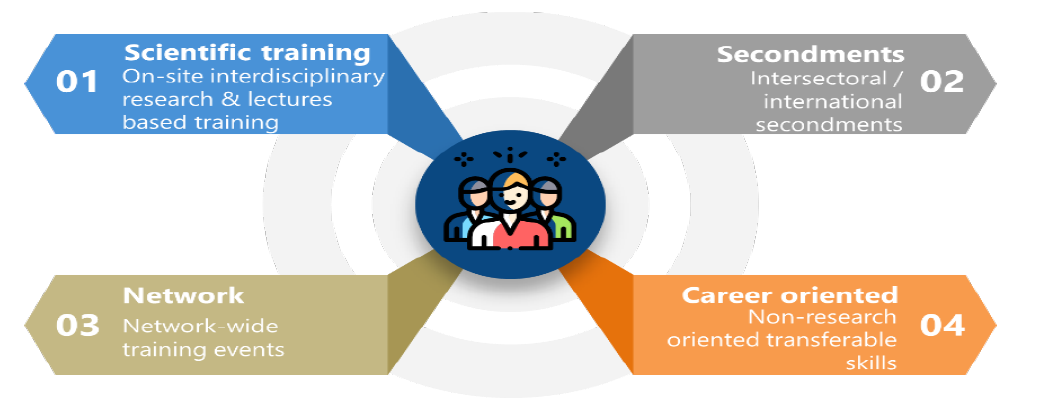
QuanG’s training programme is built upon four core pillars:
1. Scientific Training
Fellows are involved in lab-based research, collaborative projects, advanced lectures, summer schools, and dissemination through seminars, conferences, publications, and valorisation of results.
2. Secondment
Each fellow must complete a mandatory secondment, choosing between:
- 2 months in a company, or
- 4 months in a foreign research laboratory
Each fellow receives an €8,000 mobility grant to cover travel and accommodation expenses. This grant is increased to €10,000 for QuanG2 fellows.
3. Network and Community Activities
Throughout their PhD, fellows are involved in dynamic programme-wide events:
- Junior Quantum Seminar: monthly meetings with the programme director and project assistant, where one fellow presents their work. These sessions encourage exchange, peer feedback, and informal discussion.
- Out-of-Lab Day: an annual outdoor event bringing together all fellows for cross-cutting topics and team-building activities. These take place in the mountains around Grenoble.
- Quantum Seminars: participation in scientific events like the QuantAlps Days and the LANEF PhD Days.
- Quantum Day: an annual event where fellows meet with industry partners in the quantum ecosystem.
Each fellow is expected to participate in at least one of the following collective initiatives:
- Final Conference: co-organisation of the programme’s closing event
- Across the Border: summer school in 2026 with fellows from widening countries
- Sustainable Quantum: working group on the environmental impact of quantum technologies (carbon footprint, life-cycle analysis)
- Humanities for Quantum: collaborations with researchers in philosophy, history, or sociology of science
- Communicate Quantum Sciences: outreach presentations (in English) in Grenoble’s international high schools, connecting science and language learning
4. Career Development
Fellows receive tailored support for their future career path:
- Participation in relevant seminars and training sessions (scientific English, pedagogy, project management, entrepreneurship, CV writing, etc.)
- Career orientation sessions (academic and non-academic careers)
- Industrial connections through matchmaking events and secondments
- Follow-Up Committee (CSI): annual discussion on career planning and progress
- Share
- Share on Facebook
- Share on LinkedIn